
Quick answer: Aluminium, stainless steel and plastic bottles differ in weight, construction, closure and cleaning needs. Choose a specific bottle by its documented food-contact suitability and whether you need insulation, rather than assuming one material always wins.
Last Updated: September 2026 | Author: Ankit Mange, Founder, Chaze Fit | Reading Time: 8 minutes
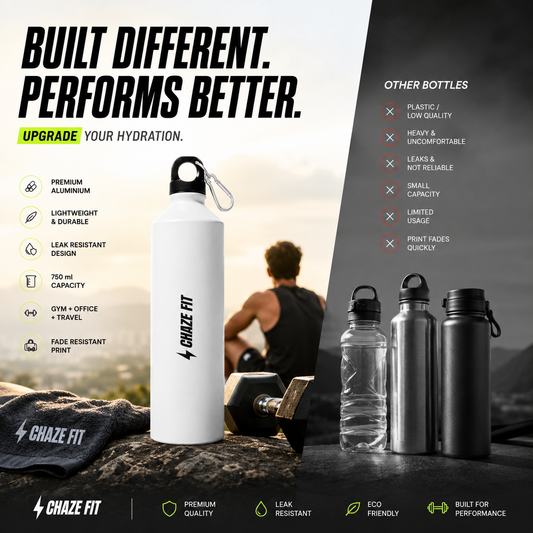
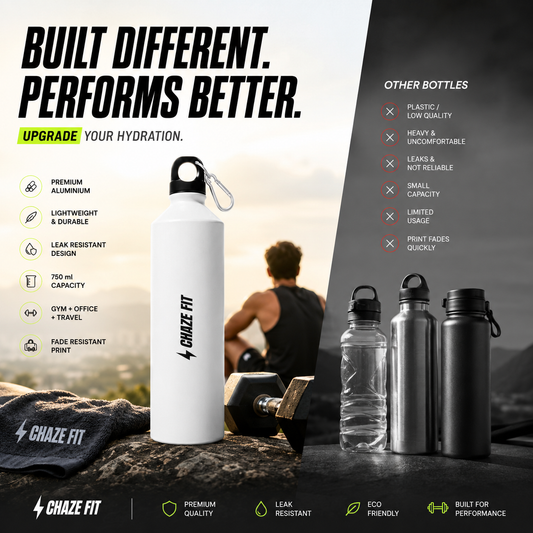
For Indian gym-goers who commute, food-grade aluminium at 750ml is the best overall gym water bottle material. It is lighter than stainless steel (180g vs 300g), keeps water cold for 3-4 hours, does not develop the plastic smell that ruins water taste within weeks, and does not leach chemicals into drinking water. If you need cold water for more than 4 hours - gym plus office, or a long commute each way - a double-wall vacuum-insulated steel tumbler is the right choice instead.
Featured Product
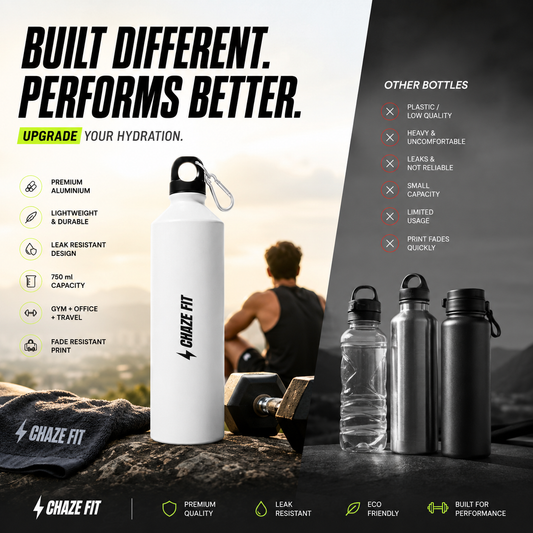
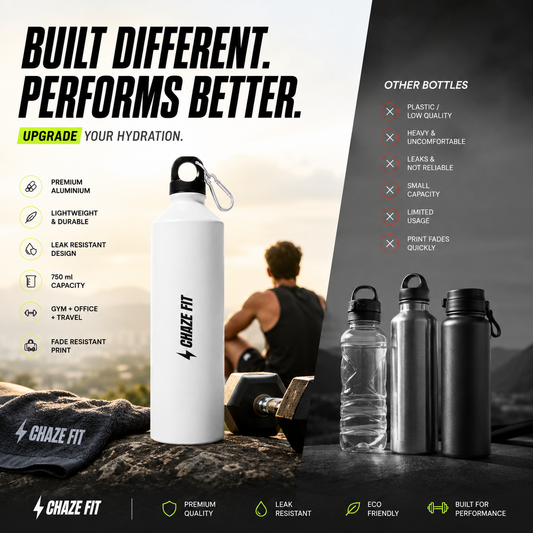
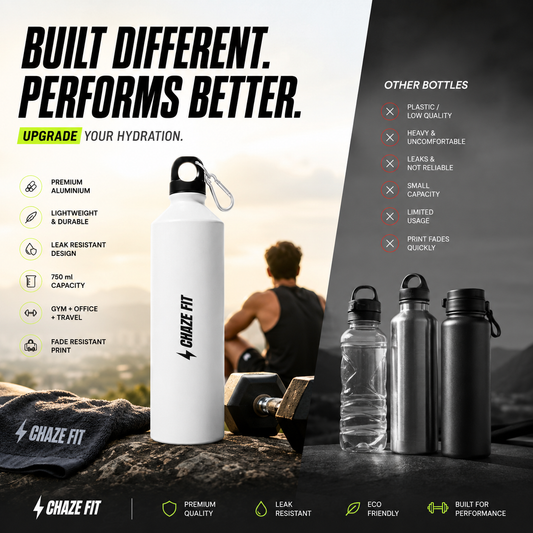
Chaze Fit Hydro Max 750ml Aluminium Gym Sipper Bottle
750ml BPA-free lightweight aluminium · ₹649
Shop Aluminium Gym Sipper Bottle →- Aluminium (750ml, food-grade): 180g. Cold 3-4 hours. Best for commuters who train once daily and want minimum bag weight.
- Steel (double-wall vacuum): 300g. Cold 12+ hours. Best for gym-to-office use where cold water must last all day.
- Plastic: 80-120g. Cold 20-30 minutes. Develops taste and odour within weeks. Not adequate for Indian gym conditions above 28°C.
- The choice between aluminium and steel depends on how long you need cold water - not on which material is universally better.
Which Material Is Actually Best For Drinking Water?
Both food-grade aluminium and 304 stainless steel are safe, non-leaching materials for daily drinking water - there isn't a single universal winner, since the right choice depends on how you'll use the bottle rather than one material being objectively superior. Aluminium's advantage is weight; steel's advantage is temperature retention and durability over time. Plastic is the weakest option for regular daily use specifically, since it degrades faster in taste, odour resistance, and insulation performance than either metal, and doesn't offer a comparable durability advantage to offset that.
Why Material Choice Matters More In India
The Physics: Thermal Conductivity By Material
In a 22°C climate-controlled gym, a plastic bottle stays adequately cool for most of a 60-minute session. In a 32°C non-AC Indian gym, that differential becomes 28°C, and heat transfers through the bottle wall proportionally faster. Every material conducts heat at a specific rate, measured in watts per metre-kelvin (W/mK). Aluminium conducts heat at roughly 205 W/mK. Stainless steel conducts at roughly 15 W/mK - about 14 times slower than aluminium. Common bottle-grade plastics conduct at roughly 0.2 W/mK - over 1,000 times slower than aluminium.
This creates a counterintuitive result: plastic is technically the slowest heat conductor of the three, yet it performs worst at keeping water cold. The reason is wall thickness and construction, not the base material's conductivity - a thin single-wall plastic bottle has almost no thermal mass to buffer temperature change. Aluminium's high conductivity would actually be a liability in a single-wall design, which is exactly why the Hydro Max's cold retention relies on aluminium's thermal mass and surface-to-volume ratio rather than trying to fight its conductivity. Steel's genuinely low conductivity, combined with a double-wall vacuum gap that removes the conduction pathway almost entirely, is what makes the Steel Edge's 12+ hour retention possible.
Founder Experience: Testing All Three On The Same Commute
I tested a plastic sports bottle, a single-wall aluminium sipper, and a double-wall steel tumbler on the same day. Each filled to 750ml at 4°C at 6am. 35-minute metro commute, 60-minute weight training session at a non-AC gym (31°C), 35-minute return commute. Plastic: warm by the 25-minute mark of training. Aluminium: still cold on the commute, cold through the first 40 minutes of training, noticeably less cold by the end. Steel tumbler: cold through the entire commute, the full session, and the return journey. For a single session with a 35-minute commute, the aluminium did the job. For anything longer, the steel was the right tool.
- Ankit Mange, Founder, Chaze Fit
How We Solved It
Material Comparison: The Data
| Factor | Plastic | Food-Grade Aluminium (Hydro Max) | Double-Wall Vacuum Steel (Steel Edge) |
|---|---|---|---|
| Empty weight | 80-120g | 180g | 300g |
| Cold retention at 30°C | 20-30 min | 3-4 hours | 12+ hours |
| Condensation | Heavy | Moderate | None |
| Odour after protein shakes | Within 4-8 weeks | Minimal with daily rinsing | None with daily rinsing |
| BPA-free | Depends on grade | Yes (food-grade anodised) | Yes (304 stainless steel) |
| Drop resistance | Cracks on 3rd drop (75cm test) | Dents but does not crack | Dents but does not crack |
| Hot beverage use | Not suitable | Not suitable | Yes (6+ hour hot retention) |
| Best use case | Occasional, short sessions | Daily gym commute, single session | Gym-to-office, all-day cold water |
| Price (Chaze Fit) | - | ₹649 | ₹999 |
Test Data · Visualised
The Weight vs Cold-Retention Trade-Off
Cold retention (longer = better)
Plastic~0.5 hr
Aluminium3-4 hr
Steel vacuum12+ hr
Empty weight (shorter = lighter to carry)
Plastic~100g
Aluminium180g
Steel vacuum300g
The core trade-off: aluminium sits in the middle on both — light enough to carry daily, cold long enough for a single session. Steel wins on cold but costs weight; plastic is lightest but warms almost immediately.
Monsoon Humidity Test: Grip And Condensation
Cold retention numbers are usually tested in dry lab conditions, but Indian monsoon humidity (routinely 80-95% RH from June through September) changes bottle handling in a way temperature data alone doesn't capture. We repeated our commute-and-session test during peak monsoon conditions.
| Material | Condensation At 30 Min (85% RH) | Grip Safety (Wet Hands + Condensation) |
|---|---|---|
| Plastic (single-wall) | Heavy - visible dripping | Reduced grip, noticeably slippery |
| Aluminium (single-wall, Hydro Max) | Moderate - damp surface, no dripping | Slightly reduced grip, manageable |
| Steel (double-wall vacuum, Steel Edge) | None - outer wall stays at ambient temperature | No grip impact - surface stays dry |
This is a second, practical reason double-wall vacuum steel outperforms single-wall metal beyond pure cold-retention time - the vacuum gap means the outer wall never gets cold enough to condense moisture from humid air.
What We Found
The commute is where the bottle must prove itself first - by the time you arrive at the gym, 30-45 minutes of heat exposure have already reduced cold retention. See our full bottle selection guide based on session length and commute. Plastic odour is a design problem, not a hygiene problem - see why bacterial growth in plastic micro-scratches accelerates at 30°C. Weight matters more than people acknowledge - the Hydro Max at 180g is the correct balance for a daily commuter, while the Steel Edge at 300g is worth carrying only if you need 12-hour cold retention. And food-grade anodised aluminium is safe for daily use - see how electrochemical anodisation creates an inert oxide layer on aluminium.
When Plastic Is Still Acceptable
- Occasional training (2-3x per week, sessions under 30 minutes)
- Testing whether you will maintain a gym routine before investing in a durable bottle
- Very short sessions where refill access makes cold retention irrelevant
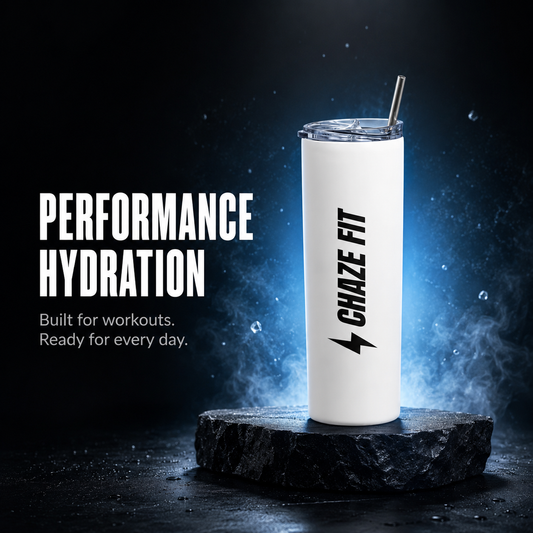
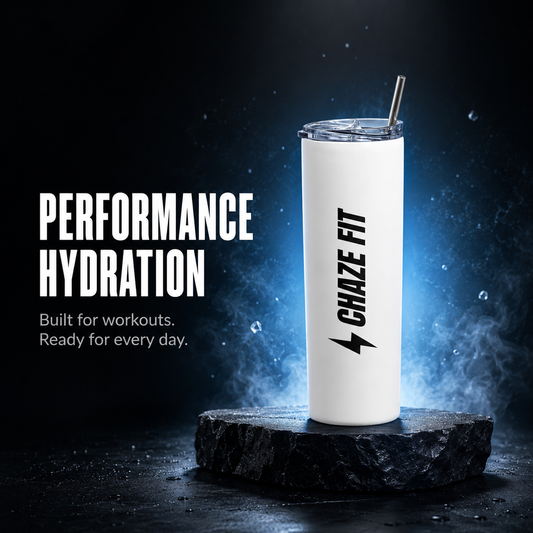
The two Chaze Fit solutions: the Hydro Max Aluminium Sipper (₹649) at 180g, 750ml, cold 3-4 hours, for daily gym commuters wanting minimum bag weight; and the Steel Edge Insulated Tumbler (₹999) at 300g, 590ml, cold 12+ hours, for gym-to-office users.
Frequently Asked Questions
Which is better for an Indian gym - aluminium or stainless steel water bottle?
For a single daily session, food-grade aluminium is better - lighter at 180g, cold for 3-4 hours. For gym-to-office use, steel is correct.
Which material bottle is best for drinking water?
Both food-grade aluminium and 304 stainless steel are safe, non-leaching choices - the right one depends on use case, not one being universally best. Plastic is the weakest choice for regular use.
Why do plastic gym bottles go warm so fast in India?
Plastic is single-wall with no insulation, so water reaches near-ambient temperature in 20-30 minutes.
Is food-grade aluminium safe for daily water use?
Yes. It has an inert oxide surface layer that does not leach into water.
Why does my plastic gym bottle smell after protein shakes?
Plastic develops micro-scratches that trap protein residue and accelerate bacterial growth.
How long does aluminium keep water cold in an Indian gym?
3-4 hours at 30°C ambient - enough for a commute plus a 60-minute session.
Is the Chaze Fit Hydro Max heavier than a plastic bottle?
Yes - 180g versus 80-120g, a deliberate trade-off for material safety and cold retention.
Can I use an aluminium water bottle for hot drinks?
Not the Hydro Max. For hot beverages, the Steel Edge is correct.
How do I clean a food-grade aluminium gym bottle?
Hand wash with warm water and mild dish soap. Rinse immediately after protein shake use.
Why is aluminium a good insulator if it conducts heat 14 times faster than steel?
The Hydro Max is single-wall and relies on thermal mass rather than fighting conductivity.
Does a bottle sweat or get slippery in Indian monsoon humidity?
Plastic and aluminium develop condensation. Double-wall vacuum steel does not.
Related Articles
- Which Bottle Type Matches Which Indian Gym Use Case
- Why Bacterial Growth In Plastic Micro-Scratches Accelerates At 30°C
- How Electrochemical Anodisation Creates An Inert Oxide Layer
- Hydro Max - Cold Retention, Commute Simulation And Drop Test Results
About The Author
Ankit Mange is the founder of Chaze Fit. He tested all three bottle materials on the same commute-and-session sequence described in this article before settling on food-grade aluminium for the Hydro Max and double-wall vacuum steel for the Steel Edge.
Follow Chaze Fit on Instagram for training tips, product drops, and behind-the-scenes testing.
Follow @chazefit →
Tags:
Previous
Why Does Water Taste Different From Different Gym Bottles?
Next
How Much Water Should You Drink During A Gym Workout In India?
Related articles
-
Aug 23 2026