

Last Updated: July 2026 | Author: Ankit Mange, Founder, Chaze Fit | Reading Time: 6 minutes
A sports bra band rides up during workouts most often because the band is too loose relative to the elastic recovery of the fabric, or because the band sits too high on the ribcage to begin with. During overhead reaches, arm raises, and torso rotation, the ribcage and surrounding muscle shift shape slightly, and a band without enough grip or the correct starting position migrates upward in response. This is a band-construction and fit issue, not something strap style or cup design can fix on its own.
Quick Summary
- Band ride-up is caused by insufficient underband grip relative to torso movement, not primarily a cup-size issue
- Overhead and reaching movements are the most common triggers, since they shift ribcage shape the most
- A correctly fitted band should sit level and snug around the ribcage, low enough that it doesn't rely on the straps for primary hold
- Wider, more structured underbands generally resist ride-up better than narrow, purely elastic ones
- A quick pre-purchase or at-home test: raise both arms fully overhead and check if the band visibly shifts upward
- Band rolling or twisting is a related but distinct issue - usually caused by insufficient band stiffness rather than looseness alone
Recommended Product
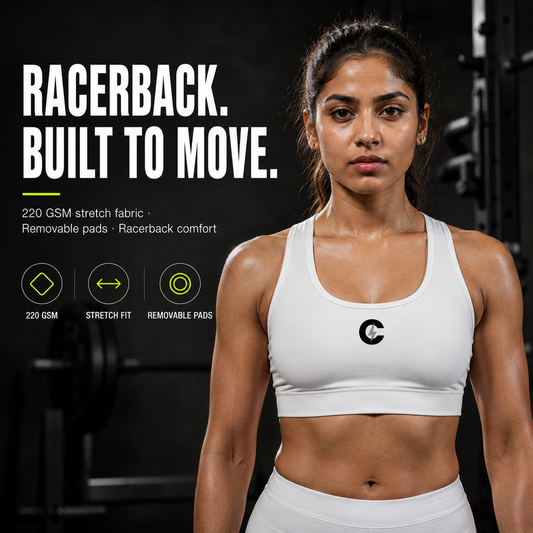
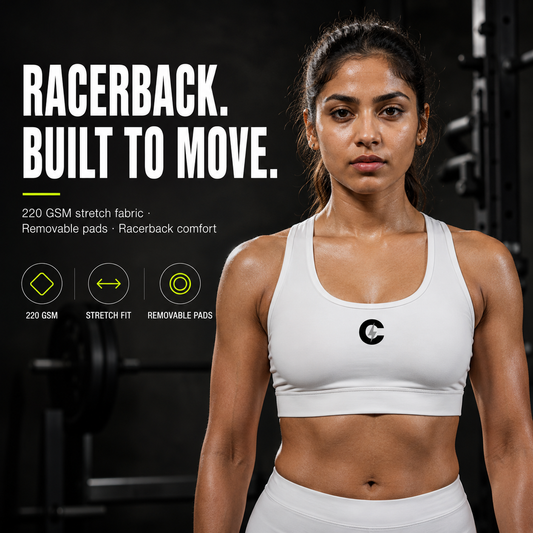
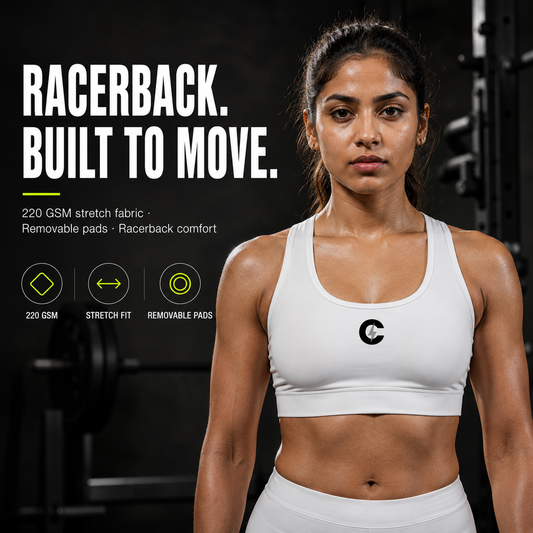
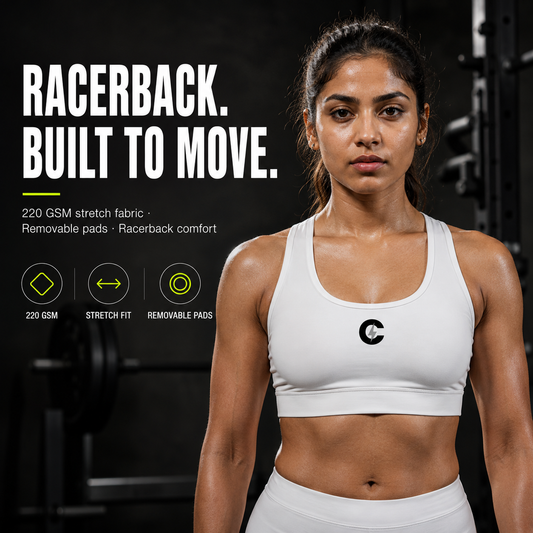
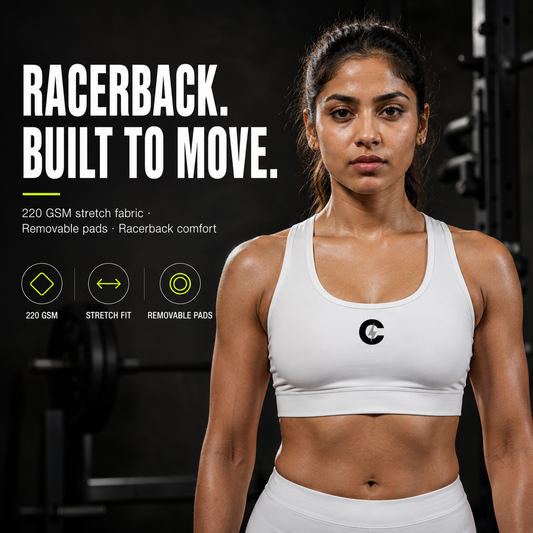
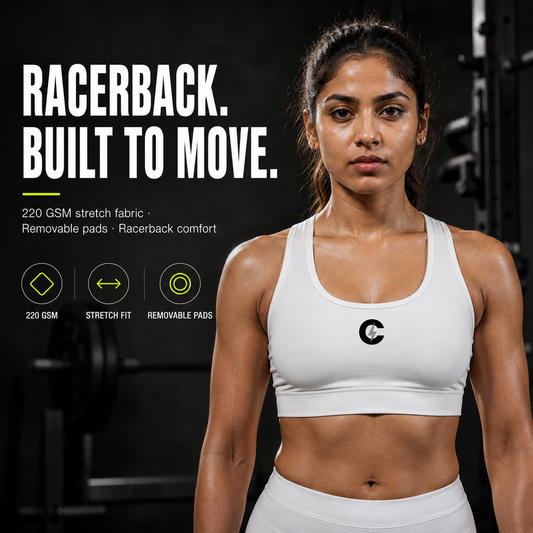
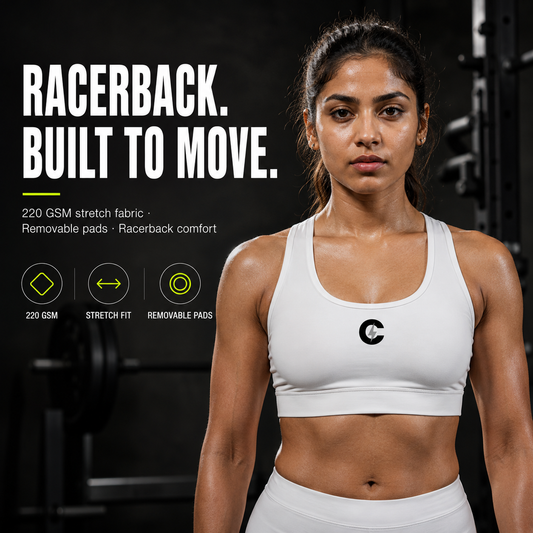
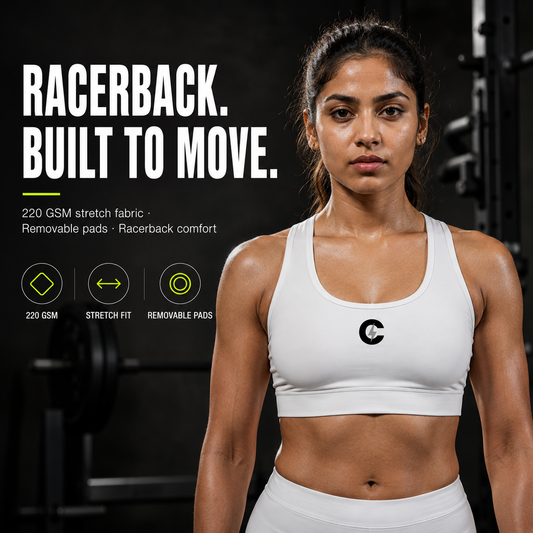
Chaze Fit AOP Racerback Sports Bra
220 GSM poly-spandex · Removable pads · Mesh lining · ₹949
Shop Non-Ride-Up Structured Band Bra →Why The Band Does Most Of The Structural Work
A common assumption is that the straps hold a sports bra in place. In a correctly fitted bra, the underband should be doing the majority of that work - the straps mainly stop the cups from gaping at the top, not carry the bra's overall position. When the band is too loose, the straps end up compensating by pulling upward and inward, which is both uncomfortable (digging into the shoulders) and ineffective, since straps alone can't prevent the band itself from creeping upward on the torso.
What Happens To The Ribcage During Overhead Movement
Raising both arms overhead expands the ribcage slightly and shifts the position of the surrounding muscle and soft tissue. A band with enough recovery and grip stays anchored through this shift. A band that's already at the loose end of its fit range, or made from a fabric with weaker elastic recovery, doesn't have enough tension to stay put - it gets pulled upward along with the shifting tissue and doesn't fully return to its original position when the arms come back down. Over a session with many overhead reps (think shoulder presses, pull-ups, or repeated overhead reaching in a HIIT circuit), this creates a gradual, cumulative upward creep.
Ride-Up vs Roll-Up: Two Different Problems
"Riding up" and "rolling up" are often used interchangeably but usually describe different failure mechanisms. Riding up is the band migrating vertically upward on the torso - a looseness and grip problem, covered above. Rolling (or twisting) is the band curling or folding over on itself while roughly staying at the same height - this is more often a stiffness problem than a looseness problem. A band made from a single thin layer of plain elastic has little resistance to folding along its own length once it's under any lateral tension, particularly during torso rotation or bending movements. A wider band with a reinforced or double-layer construction resists this folding because there's simply more structural material holding its shape.
Founder Note: What Our Panel Reported
Band ride-up came up unprompted in early testing feedback more often than any other fit issue - more than strap discomfort, more than pad shifting. Several testers specifically flagged overhead press and pull-up variations as the movements where they noticed it most. That pushed us to prioritise underband construction and grip in the final specification, rather than treating it as a secondary detail behind the print or strap design.
- Ankit Mange, Founder, Chaze Fit
How To Check For Band Ride-Up Before It Becomes A Problem
- The overhead test: With the bra on, raise both arms fully overhead a few times. Watch whether the band visibly shifts upward on your ribcage.
- The two-finger test: You should be able to fit roughly two fingers under the band at rest - snug but not restrictive. If it's looser than that, ride-up is more likely under movement.
- Check band width and construction: A wider band with reinforced elastic generally distributes grip more evenly and resists shifting better than a narrow band.
What Fixes It
- Correct band sizing: If the band consistently rides up even after the overhead test at rest, it may simply be too large - most sizing guides recommend sizing down in the band before sizing up in the cup.
- Adequate elastic recovery in the fabric: A band that has lost its stretch-recovery over time (from wear, heat, or repeated washing) will ride up more than a fresh one, even at the same nominal size.
- Structured band construction: Wider bands with reinforced or double-layer construction tend to hold position better than a single layer of plain elastic, and also resist the rolling/twisting failure separately from ride-up.
The Chaze Fit AOP Racerback Sports Bra
The Chaze Fit AOP Racerback Sports Bra (₹949) uses a structured underband as part of its 220 GSM poly-spandex construction, specifically to address the overhead-movement ride-up pattern our testing identified. For the complete specification guide, read our article on the complete guide to sports bras for Indian gym-goers.
Related Articles
- The Complete Guide To Sports Bras For Indian Gym-Goers
- Does A Racerback Sports Bra Mean More Support?
- What Support Level Sports Bra Do You Actually Need?
Frequently Asked Questions
Q1: Why does my sports bra band move up during my workout?
Usually because the band is too loose relative to the fabric's elastic recovery, or sits too high to begin with. Overhead and reaching movements shift ribcage shape and pull an inadequately anchored band upward.
Q2: How do I test if a sports bra band will ride up before buying?
Raise both arms fully overhead a few times while wearing it and watch whether the band visibly shifts. This mimics the movement that causes ride-up most commonly during training.
Q3: Should the band or the straps hold a sports bra in place?
The band should do the majority of the work. If you find yourself relying on tight straps to keep the bra positioned, the band is likely too loose.
Q4: Does band size matter more than cup size for fit?
For preventing ride-up specifically, yes - band fit is the primary factor. Most sizing guidance recommends prioritising a snug, correctly sized band over cup size when in doubt.
Q5: Can a worn-out sports bra start riding up even if it fit fine before?
Yes. Elastic recovery in the band degrades with wear, heat exposure, and repeated washing over time, which can cause a previously well-fitting bra to start riding up.
Q6: Why does my sports bra band roll up or twist instead of staying flat?
Rolling or twisting is usually a different issue from riding up - it typically means the band lacks structural stiffness, not just tightness. A band that's snug enough to stay in position vertically can still curl or fold over on itself if the underband fabric is too thin or lacks a reinforced construction. This is more common on very budget bras with a single layer of plain elastic rather than a wider, structured band.
Follow Chaze Fit on Instagram for training tips, product drops, and behind-the-scenes testing.
Follow @chazefit →About The Author
Ankit Mange is the founder of Chaze Fit. Band construction and ride-up testing across overhead movement patterns, described in this article, directly shaped the underband specification of the AOP Racerback Sports Bra.
Tags:
Previous
Does A Racerback Sports Bra Mean More Support?
Next
What Support Level Sports Bra Do You Actually Need?
Related articles
-
Aug 07 2026
Buy AOP Racerback Sports Bra Online: Price & Sizes
-
Jul 19 2026