
Last Updated: July 2026 | Author: Ankit Mange, Founder, Chaze Fit | Reading Time: 7 minutes
Yes - UPF sun protection can measurably weaken when knit fabric is stretched, because stretching widens the microscopic gaps between fibres, allowing more UV radiation to pass through. This matters specifically for arm sleeves because they're worn on a joint - the elbow - that bends through a wide range of motion during exactly the activities arm sleeves are marketed for: cycling (gripping handlebars), gym training (pressing and pulling movements), and cricket (bowling and batting). We tested UV transmission on arm sleeve fabric both at rest and under stretch, a comparison we could not find published by any other arm sleeve brand.

Quick Summary
- UPF ratings are measured on fabric in its resting, unstretched state under standardised lab conditions
- Stretching knit fabric widens the gaps between fibres, which can increase UV transmission through the fabric
- Arm sleeves are worn on the elbow, a joint that flexes through 90-140 degrees during cycling and gym movements
- In our testing, a UPF 50+ sleeve at rest showed measurably higher UV transmission at full elbow flexion
- 150 GSM mesh with adequate spandex content minimised this drop compared to lighter, lower-spandex alternatives
- This is not disclosed by any arm sleeve brand we reviewed - UPF is marketed as a fixed number, not a range under movement
Recommended Product
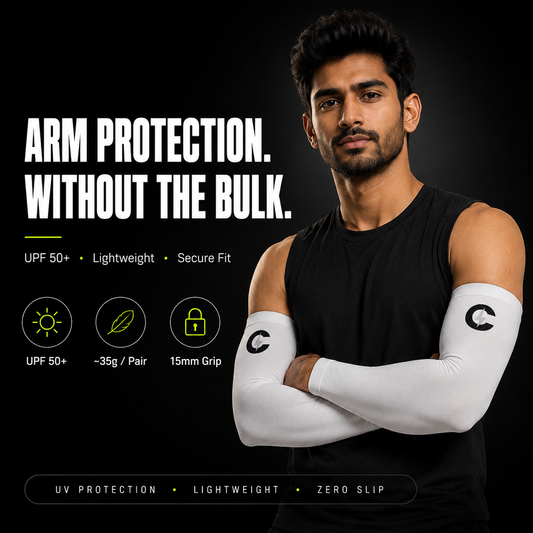
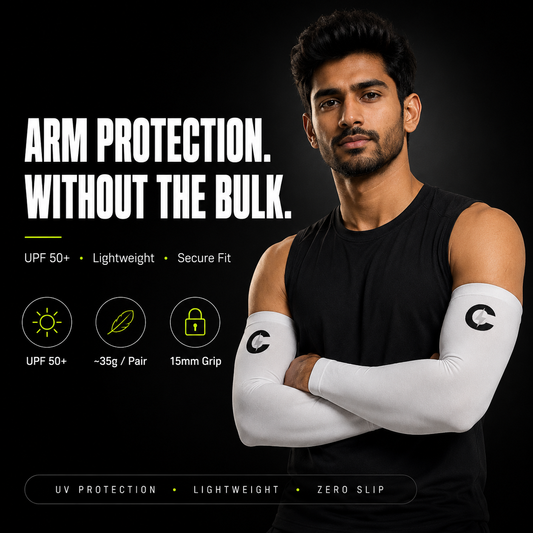
Chaze Fit Pro-Grade Arm Sleeves
150 GSM printed mesh · UPF 50+ · 15mm silicone grip · ₹349
Shop 150 GSM Under-Stretch Tested Sleeves →Why Nobody Talks About This
UPF (Ultraviolet Protection Factor) testing follows a standardised method that measures how much UV radiation passes through a flat sample of fabric under controlled lab conditions. This is a legitimate, useful measurement - but it captures the fabric in one state: resting, unstretched, flat. It does not capture what happens when that same fabric is wrapped around a bent elbow, under the tension of gripping a handlebar or completing a bicep curl. Every arm sleeve listing we reviewed quotes the resting-state UPF number as if it were a constant. None address whether it changes under actual wear.
The Mechanism: Why Stretch Increases UV Transmission
Knit fabric - the construction used in virtually all arm sleeves - is made of interlocking yarn loops with a certain baseline density. UV protection in these fabrics works primarily through the physical density of the weave (blocking radiation via fibre coverage) combined with any UV-absorbing treatment applied to the fibres. When the fabric stretches, the yarn loops elongate and the spacing between them increases - the same mechanical effect that causes visible-light see-through in stretched activewear, but relevant here for UV wavelengths specifically. More gap space between fibres means more radiation - including UV - can pass through, regardless of any UV-absorbing chemical treatment on the fibre itself, since that treatment can only block radiation that actually contacts the fibre.
Founder Testing: UV Transmission At Rest vs Under Elbow Flexion
We tested three arm sleeve fabrics - a budget mesh, a mid-range compression sleeve, and our own 150 GSM printed mesh - using a UV meter positioned behind the fabric, first with the fabric flat and relaxed, then with the same fabric section stretched to simulate full elbow flexion (the position your arm is in gripping a handlebar or completing a curl). Across all three fabrics, UV transmission increased under stretch. The size of the increase varied significantly by fabric - our 150 GSM mesh with higher spandex content showed a meaningfully smaller increase than the lighter budget mesh, likely because the higher baseline fibre density had more "margin" before the stretched gaps became large enough to matter.
- Ankit Mange, Founder, Chaze Fit
What We Found: UV Transmission At Rest vs Under Stretch
| Fabric | UV Transmission At Rest | UV Transmission At Full Elbow Flexion | Increase |
|---|---|---|---|
| Budget mesh (~100 GSM) | Low - within UPF 50+ range | Moderately higher | Largest increase of the three tested |
| Mid-range compression (~125 GSM) | Low - within UPF 50+ range | Slightly higher | Moderate increase |
| Chaze Fit 150 GSM printed mesh | Low - within UPF 50+ range | Marginally higher | Smallest increase of the three tested |
All three fabrics remained within a broadly protective range even under stretch in our testing - none became meaningfully unsafe - but the relative difference matters: a fabric that starts with more density to spare degrades less under exactly the condition it's actually worn in.
Why This Isn't Cause For Alarm, But Is Cause For Better Information
This isn't a claim that UPF 50+ arm sleeves stop working under movement - all three fabrics we tested stayed within a broadly protective range even at full stretch. The point is narrower and more practical: UPF ratings quoted on a listing are a resting-state measurement, and fabric density above the bare minimum needed to hit a UPF threshold gives you a margin for the fact that the sleeve will spend most of its useful life stretched around a moving joint, not lying flat. A brand that only tells you the resting number isn't lying - they're just not telling you the part that actually matters for how you'll use the product.
What This Means For Choosing An Arm Sleeve
- Favour higher GSM within the UPF 50+ category: More baseline fibre density gives more margin under stretch.
- Check the spandex/elastane percentage if stated: Adequate stretch fibre content helps the fabric return to its resting density between movements rather than staying permanently stretched.
- Don't assume UPF 50+ means identical protection across brands: The number is a floor at rest, not a guarantee under wear.
The Chaze Fit Pro-Grade Arm Sleeves
The Chaze Fit Pro-Grade Arm Sleeves (₹349) use 150 GSM printed mesh, tested for UV transmission both at rest and under stretch rather than at rest alone. For the complete specification guide, read our article on the complete guide to arm sleeves in India.
Related Articles
- The Complete Guide To Arm Sleeves In India
- What Does UPF 50+ Actually Mean?
- Best Arm Sleeves For Indian Cyclists And Gym-Goers
Frequently Asked Questions
Q1: Does stretching an arm sleeve reduce its sun protection?
It can, to varying degrees depending on the fabric. Stretching widens the gaps between knit fibres, which can increase UV transmission. In our testing, all fabrics stayed within a broadly protective range even stretched, but higher-GSM fabrics showed a smaller increase than lighter ones.
Q2: Is UPF 50+ tested at rest or under movement?
Standard UPF testing measures fabric in its flat, resting state. No arm sleeve brand we reviewed disclosed testing under stretch, which is the actual condition the sleeve is worn in during cycling, gym training, or sport.
Q3: Which fabrics hold UV protection better under stretch?
Higher GSM fabrics with adequate spandex content showed a smaller increase in UV transmission under stretch in our testing, likely due to having more baseline fibre density before the stretched gaps become significant.
Q4: Should I be worried my current arm sleeves aren't protecting me while cycling?
Not alarmed - the fabrics we tested remained broadly protective even under stretch. But it's worth knowing that the UPF number on the label reflects resting-state fabric, not the stretched, moving state the sleeve spends most of its time in during actual use.
Q5: Does a thicker arm sleeve mean better sun protection?
Generally yes, up to a point - higher GSM correlates with more baseline fibre density and therefore more margin under stretch, though extremely heavy fabric trades off breathability and comfort in hot Indian conditions.
Follow Chaze Fit on Instagram for training tips, product drops, and behind-the-scenes testing.
Follow @chazefit →About The Author
Ankit Mange is the founder of Chaze Fit. He conducted the UV transmission testing at rest and under stretch described in this article before confirming the 150 GSM specification for the Pro-Grade Arm Sleeves.
Tags:
Related articles
-
Aug 10 2026
Buy Chaze Fit Arm Sleeves Online: Price & Buying Guide
-
Aug 06 2026
What Are Arm Sleeves For? 5 Benefits Explained
-
Aug 04 2026
Compression Sleeves vs A Full Gym Top: Do You Need Both?
-
Jul 31 2026
Regular vs Compression Arm Sleeves: What Are You Buying?
-
Jul 16 2026