Arm Sleeve Coverage in Motion: Upper-Arm Fit, Wrist Gaps and Care
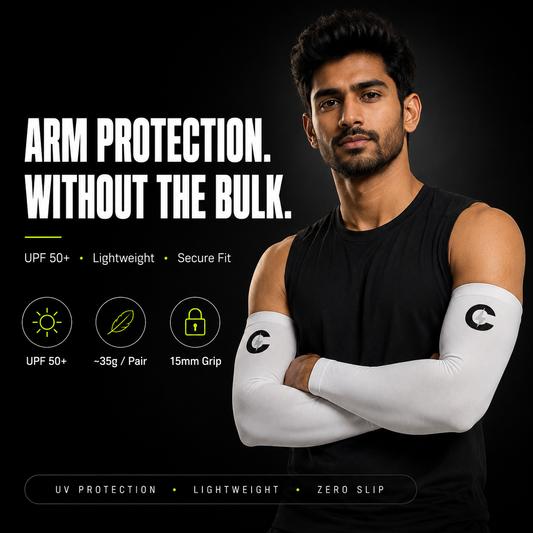
At a glance: Check sleeve length and upper-arm fit with the short-sleeve top you actually wear. Chaze Fit Arm Sleeves use 150 GSM mesh and a 15 mm silicone grip band, with UPF 50+ stated in the product listing.
Author: Ankit Mange, Founder, Chaze Fit.
Removable sleeves are useful to compare when you want to change arm coverage without changing the entire top. The important detail is how that coverage behaves in the position you actually use. Standing with arms relaxed is different from reaching forward on a bicycle or swinging the arms while running.
Plan coverage as an outfit. The short-sleeve hem, upper sleeve edge and wrist position form separate boundaries. A gap at one boundary is not covered by the fabric elsewhere. This practical view keeps the fit decision focused on length and positioning rather than relying solely on a rating printed in the listing.

Map the coverage before selecting a size
Use the product’s length and circumference guidance where available, and request missing measurements before ordering. A Standard option is a size label, not a universal-fit guarantee. Compare the guidance with your arm measurements and the position of the top you intend to wear.
Chaze Fit lists 150 GSM mesh, a 15 mm silicone grip band and UPF 50+ for its arm sleeves. The grip is intended to help positioning; it does not eliminate the need for suitable fit. Excessive tightness is not a useful way to compensate for slipping. Keep the fabric comfortably positioned and avoid assuming these sports accessories provide medical compression, injury treatment or impact protection.
Overlap with a short-sleeve top
Both garments move with your arm. Check their overlap in your normal riding or running position, and ask for sleeve length if you need a specific amount of coverage.
Rolling at the upper band
Review placement, sizing and fabric condition. Avoid solving movement by excessive tightening; the band should remain comfortable through the movements you intend to make.
Interpreting Standard sizing
Ask for the suitable arm-circumference range and sleeve measurements. Standard is an option label, not proof that one sleeve fits every arm.
Sleeves and full-sleeve tops
They provide separate arm coverage, while a full-sleeve top also covers the torso and shoulders. Choose around the area you want covered; these sleeves are not winter warmers or protective armour.
Care between outings
Hand wash in cool water and air dry as instructed. Inspect the fabric and grip, and avoid excessive stretching or putting the sleeves away while damp.
Practical checks before choosing
| What you notice | What to check |
|---|---|
| Gap appears when reaching | Check sleeve length and top overlap |
| Band rolls or slips | Review fit and placement |
| Size range is missing | Request circumference guidance |
| Fabric stretched or damaged | Reassess condition before use |
Putting the choice into practice
Sun-protection planning should account for uncovered areas and fabric condition. The Skin Cancer Foundation explains that fit and stretching can affect clothing protection; a fabric rating does not cover gaps at the wrist or upper arm. Follow the product guidance and use sleeves as one part of an appropriate outdoor setup. Check them after washing and before use rather than assuming the original fit remains unchanged indefinitely.
Explore UV Arm Sleeves – UPF 50+ for Running & Cycling at Chaze Fit — review current specifications and available options before selecting yours.
Tags:
Related articles
-
Aug 10 2026
Buy Chaze Fit Arm Sleeves Online: Price & Buying Guide
-
Aug 04 2026
Compression Sleeves vs A Full Gym Top: Do You Need Both?
-
Jul 31 2026