
Last Updated: July 2026 | Author: Ankit Mange, Founder, Chaze Fit | Reading Time: 7 minutes
Sweat drips into your eyes during gym workouts because the forehead has one of the highest sweat gland densities on the human body - approximately 175-200 eccrine glands per square centimeter. During moderate-to-high intensity training, these glands produce sweat faster than most headbands can absorb or wick it away. Once the headband saturates (typically 15-20 minutes for cotton in Indian gym conditions), gravity channels all remaining sweat directly toward the eyes. The solution is a quick-dry headband that never reaches saturation, paired with a silicone grip that holds position when the head surface is wet.
Featured Product
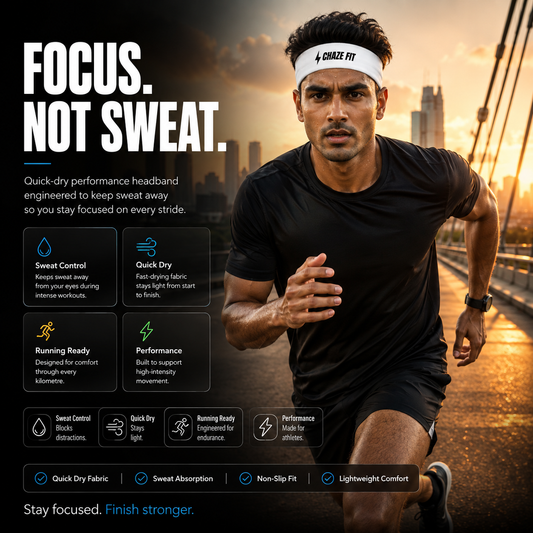
Chaze Fit Grip Flex Non-Slip Sports Headband
Non-slip silicone grip · Quick-dry · ₹499
Shop Quick-Dry Sweat-Wicking Headband →Quick Summary
- The forehead contains 175-200 eccrine sweat glands per cm2 - one of the body's highest concentrations
- Cotton headbands saturate within 15-20 minutes in Indian gym conditions (28-36°C ambient)
- Once saturated, every subsequent sweat drop channels directly toward the eyes
- Indian non-AC gyms produce 30-60% more sweat per session than 22°C climate-controlled gyms
- Quick-dry polyspandex wicks moisture continuously and never reaches saturation during a 60-minute session
- A silicone grip strip holds position even when both the headband and head surface are wet
Why Does Sweat Drip Into Eyes During Exercise?
Sweat drips into eyes during exercise because the forehead contains approximately 175-200 eccrine sweat glands per square centimeter. During moderate-to-high intensity training, these glands activate within 5-10 minutes and produce sweat at rates that exceed the absorption capacity of standard cotton headbands within 15-20 minutes. Once a cotton headband reaches saturation, it stops absorbing sweat and begins dripping - gravity channels this flow downward along the forehead's natural contours directly toward the eyes. In Indian non-AC gym conditions at 28-36°C, sweat rate is 30-60% higher than in climate-controlled gyms, accelerating saturation significantly.
Why Your Forehead Produces So Much Sweat
The forehead is one of the body's primary thermoregulatory sites. The brain - housed immediately beneath the forehead - is highly sensitive to temperature. The body prioritizes cooling the skull through high sweat gland density in this region, even during moderate exercise. During a standard 60-minute weight training session in a 30°C Indian gym, an average gym-goer produces 0.5-1.2 liters of total sweat, a significant fraction from the forehead and scalp.
Why Indian Gym Conditions Make This Problem Worse
- Mumbai: 28-34°C in summer months (March-October)
- Chennai: 30-36°C year-round in most non-AC facilities
- Delhi: 32-40°C in May-June
- Hyderabad: 28-35°C in pre-monsoon months
A cotton headband that manages sweat adequately for 30 minutes in a 22°C gym will saturate in 15 minutes in a 30°C non-AC Mumbai gym. International headband products routinely underperform their stated specifications in Indian conditions.
What We Found Testing Across Different Training Types
We didn't expect running to produce headband failure faster than weight training, but our early testing showed exactly that. A 5km tempo run in Mumbai monsoon conditions (30°C, 85% relative humidity) saturated a standard cotton headband in under 12 minutes - faster than any weight training session in our data at the time. The reason turned out to be sweat rate consistency, not sweat rate peak: a lifting session has rest intervals between sets where sweat production dips, but a sustained run holds heart rate and core temperature elevated continuously, producing a steadier, higher average sweat rate over time. That single finding told us the headband couldn't be designed around gym-only conditions - it had to handle continuous high-output activity too, which is part of why the final Grip Flex spec was tested across running, HIIT, and yoga, not just weight training.
- Ankit Mange, Founder, Chaze Fit
Sweat Rate Varies By Activity Type, Not Just Temperature
Ambient temperature is only one variable in how fast a headband saturates. The activity pattern itself - continuous output versus interval-based output - changes the sweat rate curve significantly. We logged time-to-saturation for a standard cotton headband across four common Indian gym activity types, all at a comparable 30-31°C ambient.
| Activity Type | Output Pattern | Cotton Headband Saturation Time |
|---|---|---|
| Tempo running (continuous) | Sustained high output, no rest | 10-12 minutes |
| HIIT circuit | High output with short rest intervals | 13-16 minutes |
| Heavy weight training | High output bursts with longer rest between sets | 15-20 minutes |
| Hot yoga / vinyasa flow | Sustained moderate output, elevated ambient heat | 11-14 minutes |
Continuous-output activities (running, hot yoga) saturate a cotton headband faster than interval-based weight training, even though weight training often feels more intense in the moment. This is why the Chaze Fit Grip Flex was tested across all four activity types rather than gym sessions alone - a headband spec that only accounts for lifting's rest-interval pattern would underperform on a run or in a flow-based yoga class.
The Two-Stage Failure: How Cotton Headbands Stop Working
Stage 1: Absorption Phase (Minutes 0-18)
Cotton fibers absorb sweat into their structure. The headband is working correctly. No visible problem.
Stage 2: Saturation Phase (Minutes 18+)
Cotton fiber structure reaches capacity. No additional sweat can be absorbed. Every new sweat drop flows straight through the saturated fabric. Simultaneously, the extra weight of saturated fabric (cotton headbands increase from 35g dry to 80-100g saturated) reduces friction and begins sliding forward. Both failures happen within minutes of each other.
What We Tested: Sweat Absorption Rates Across 4 Headband Types
| Headband Type | Ambient Temp | Saturation Time | Grip Duration (Wet) | Post-Saturation Effect |
|---|---|---|---|---|
| 100% Cotton | 30°C | 15-18 min | 20-25 min | Drips, slides, requires removal |
| Cotton-poly blend | 30°C | 22-28 min | 28-35 min | Slower drip, still slides by 35 min |
| Performance poly (tension-only grip) | 30°C | Does not saturate | 18-22 min | Does not drip, slides when head wet |
| Chaze Fit Grip Flex (polyspandex + 4mm silicone) | 30°C | Does not saturate | 60+ min | Functional throughout full session |
The Complete Solution: What A Headband Must Do
- Continuous moisture management without saturation: Only quick-dry polyspandex achieves this.
- Non-slip grip on a wet head surface: Only a silicone inner grip strip achieves this reliably. For the full material science behind why silicone works where fabric fails, read our article on how the Si-O polymer backbone gives silicone its moisture-resistant friction.
The Chaze Fit Grip Flex Sports Headband solves both. For the full materials comparison with saturation timing data, read our saturation timing data from a controlled 31°C gym test.
Related Articles
- 5 Prototype Iterations That Produced The Grip Flex Specification
- Saturation Timing Data - Cotton vs Polyspandex At 31°C
- Grip Flex Scored 9.4/10 - Full Criteria Breakdown
- How Silicone's Si-O Backbone Makes It Moisture-Resistant
Frequently Asked Questions
Q1: Why does sweat drip into my eyes during workouts?
Because the forehead has a very high concentration of eccrine sweat glands (175-200 per cm2) that activate during exercise. In warm Indian gym conditions, these glands produce sweat faster than cotton headbands can absorb it. Once the headband saturates at 15-20 minutes, gravity channels sweat directly toward the eyes.
Q2: How do I stop sweat from dripping into my eyes at the gym?
Wear a quick-dry polyspandex sports headband with a silicone inner grip strip, minimum 4cm wide. The Chaze Fit Grip Flex meets both specifications and was tested through 60 non-AC gym sessions without requiring repositioning.
Q3: Why does my headband keep sliding off during exercise?
Standard headbands use fabric-on-skin tension for grip. When sweat wets the head surface, this friction drops 35-40%. A silicone inner grip strip solves this - silicone's friction against wet skin drops only 10-15%.
Q4: How long does a cotton gym headband last before it starts dripping?
In Indian non-AC gym conditions at 28-36°C, cotton headbands saturate and begin dripping within 15-20 minutes of moderate-to-high intensity training. In climate-controlled gyms at 22°C, the same headbands last 30-40 minutes.
Q5: Is it normal to sweat so much from the forehead during exercise?
Yes. The forehead has one of the body's highest eccrine sweat gland densities because the brain beneath it is highly temperature-sensitive. Heavy forehead sweating during exercise is physiologically normal, not a sign of poor fitness.
Q6: What is the best gym headband for sweating a lot in India?
A quick-dry polyspandex headband with a 4mm silicone inner grip strip, 4cm wide, under 35g. The Chaze Fit Grip Flex does not saturate during a 60-minute session in Indian conditions and holds position throughout.
Q7: Does sweating into eyes during exercise affect performance?
Yes. Sweat entering the eyes causes momentary blurred vision and burning, breaking concentration at critical moments - particularly during heavy compound lifts and HIIT intervals.
Q8: Will a sweatband stop sweat from entering my eyes?
Yes, if correctly specified. A forehead headband of minimum 3.5cm width in quick-dry fabric with silicone grip will prevent sweat from reaching the eyes throughout a full training session in Indian conditions.
Q9: Why does sweat burn my eyes during gym?
Sweat is mildly acidic (pH 4.5-5.5) and contains sodium, potassium, and trace electrolytes. The acidic pH and electrolyte concentration cause the characteristic burning sensation and transient blurred vision.
Q10: How much does forehead sweat increase in a hot gym?
Sweat rate increases approximately 10-15% for every 1°C rise in ambient temperature during exercise. Between a 22°C climate-controlled gym and a 30°C non-AC Indian gym, sweat rate increases 30-60% for the same workout intensity.
Q11: Can a cotton headband be made non-slip?
Not meaningfully. Slippage has two causes: increased weight from water absorption (80-100g saturated vs 35g dry) and reduced friction when the head surface is wet. Both are inherent to cotton. A silicone grip strip is the correct solution.
Q12: What is the best headband for HIIT training in India?
Quick-dry polyspandex with 4mm silicone grip, 4cm wide. HIIT involves the highest sweat rates of any common gym training format. This specification was tested across HIIT sessions in non-AC Mumbai gyms and maintained full performance throughout.
Q13: Does running cause headbands to fail faster than weight training?
Yes, in our testing. A continuous-output activity like tempo running saturated a cotton headband in 10-12 minutes versus 15-20 minutes for weight training, because running sustains a steady high sweat rate without the rest intervals that punctuate a lifting session.
About The Author
Ankit Mange is the founder of Chaze Fit. The cross-activity saturation testing described in this article - covering running, HIIT, weight training, and hot yoga - directly shaped the final Grip Flex specification.
Follow Chaze Fit on Instagram for training tips, product drops, and behind-the-scenes testing.
Follow @chazefit →
Tags:
Previous
The Complete Guide To Sports Headbands In India
Next
Cotton vs Synthetic Sports Headband: Which Is Better For Indian Gyms?
Related articles
-
Sep 06 2026
Athletic Headbands For Keeping Hair Back During Workouts
-
Jul 31 2026
Best Headband Width For Running vs Weightlifting vs Yoga
-
Jun 13 2026