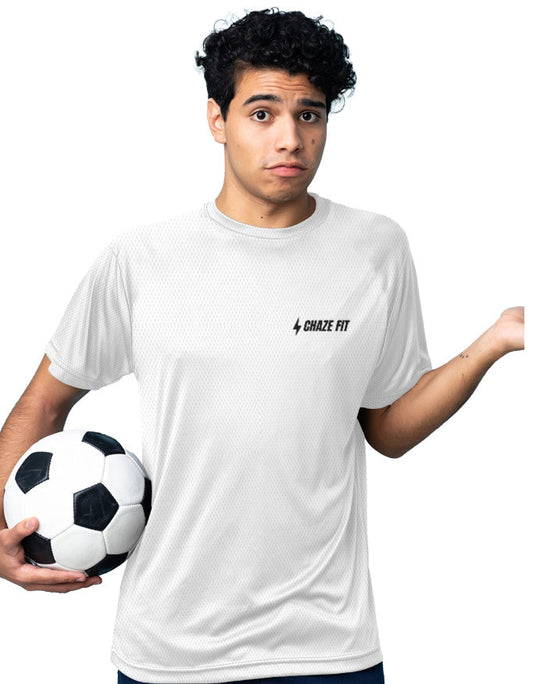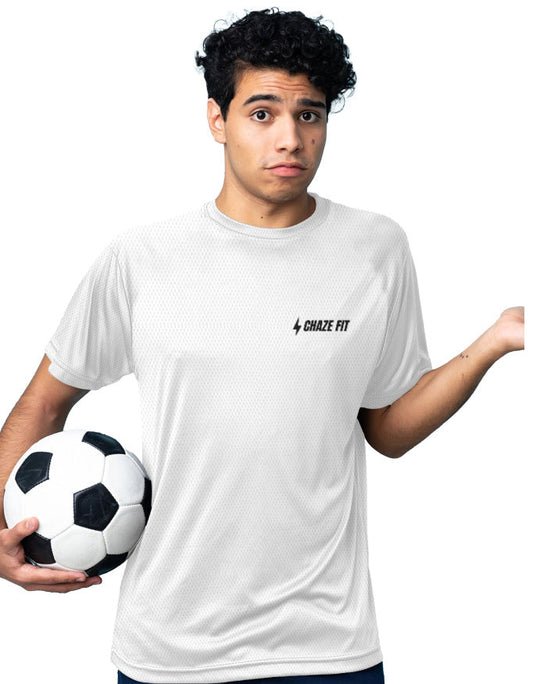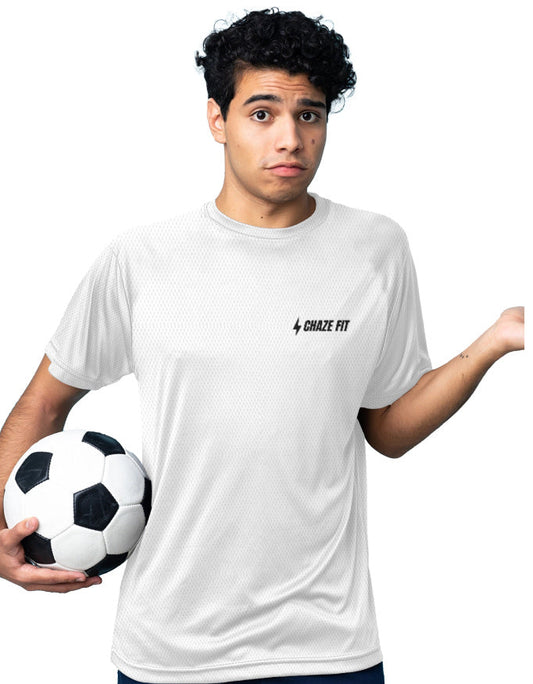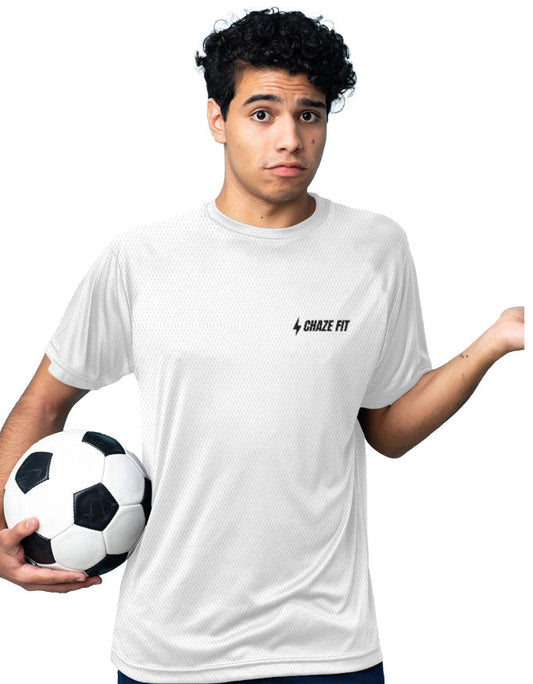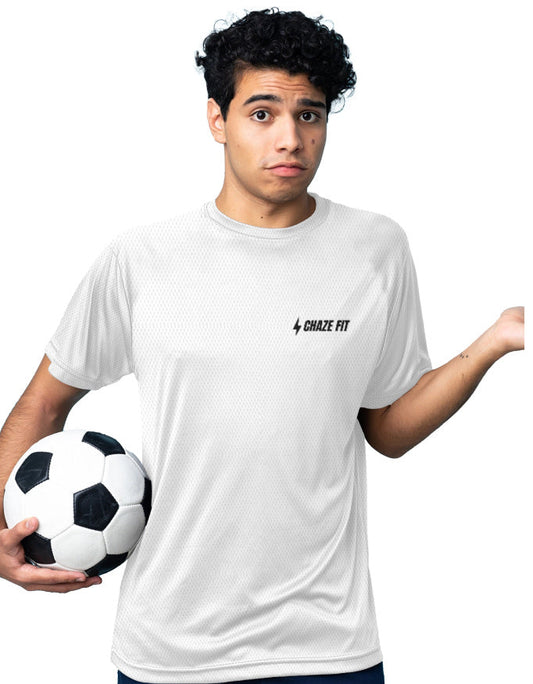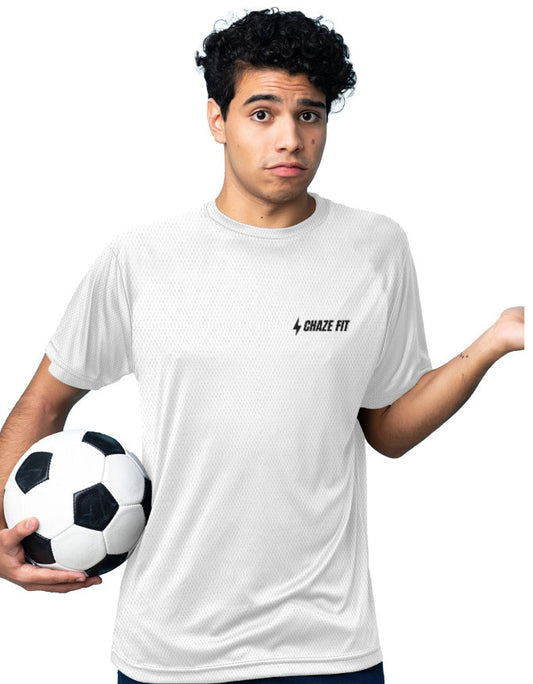

Direct answer: A gym tee turns see-through and clings when wet because of two combined factors: a low fabric weight (usually under 150 GSM) and a flat, tightly woven polyester structure with no wicking finish, which lets sweat sit on the surface instead of spreading and evaporating. Fixing it means choosing a heavier open-mesh knit - around 170 GSM - with a genuine moisture-wicking treatment, like the Chaze Fit Dri-Fit Sports T-Shirt, rather than assuming any "dri-fit" label solves the problem.
Featured Product
Chaze Fit Dri-Fit Sports T-Shirt
170 GSM poly mesh · Dri-Fit moisture-wicking · ₹799
Shop Opaque-When-Wet Dri-Fit Tee →
It's Not Bad Luck - It's Fabric Weight And Weave
If you've ever caught your reflection mid-set and noticed your tee has gone see-through across the chest or back, the instinct is to blame sweat volume - "I just sweat a lot." But two people can sweat the same amount in the same tee and get different results depending entirely on what the fabric is doing with that moisture. The real variables are fabric weight (GSM) and weave structure, not how much you sweat.
Light fabric - typically anything under 150 GSM - simply doesn't have enough fibre density to stay opaque once water fills the gaps between threads. Water changes how light passes through fabric, and thin fabric has fewer fibres to scatter that light before it gets to your skin tone underneath. This is why a 170 GSM tee and a 130 GSM tee in the exact same colour can behave completely differently the moment they're both damp.
Weave structure compounds the problem. A flat, tightly-woven polyester fabric with no wicking finish holds sweat right where it lands instead of spreading it. That concentrated wet patch is exactly where see-through happens first - usually the centre of the chest and the lower back, the two areas with the most direct sweat contact.
Why Clinging Happens Alongside See-Through
Clinging and see-through usually show up together because they share the same root cause: fabric that doesn't move moisture away from skin. Once a flat-weave polyester tee is wet, surface tension pulls the fabric against your body - there's no air gap left between skin and fabric because the moisture has nowhere else to go. A genuine wicking finish interrupts this by pulling sweat along the fibre to the outer face of the fabric, spreading it thin across a wider surface area instead of letting it pool under the shirt.
Open mesh knits help further because the gaps built into the structure let air move through the fabric even while it's damp, which reduces the vacuum-seal effect that makes a flat-weave tee stick to skin.
"See-through tees were one of the first complaints we heard about generic dri-fit gym wear when we started testing fabric for this tee. It's almost always a GSM problem, not a sweat problem - people think they need to sweat less, when really the fabric just isn't dense or open enough to do its job." - Ankit Mange, Founder, Chaze Fit
The GSM Sweet Spot
Go too light (under 150 GSM) and you get see-through fabric with poor print retention. Go too heavy (200 GSM+) and you lose the airflow that makes mesh worth choosing over cotton in the first place - the fabric starts behaving more like a t-shirt than a technical training tee. 160-180 GSM open poly mesh is the working range that stays opaque when wet while still breathing through a full session. The Chaze Fit Dri-Fit Sports T-Shirt sits at 170 GSM specifically for this reason - see the full breakdown in our poly mesh fabric explainer.
Colour Makes It Worse (But Isn't The Root Cause)
Very light colours, especially white, show wet patches more visibly than darker colours - but a dark, thin-fabric tee still turns semi-transparent when wet, it's just harder to see at a glance. Colour affects visibility of the problem, not whether the problem exists. Fixing GSM and weave fixes the actual cause regardless of colourway.
Four Things That Actually Fix It
1. Check GSM before assuming any "dri-fit" tee works the same. "Dri-fit" is a marketing term applied to fabrics ranging from 120 GSM to 200 GSM - the number matters more than the label.
2. Choose open mesh over flat weave. A knit structure with built-in air channels moves moisture and heat away from skin far more effectively than a tightly woven flat polyester.
3. Confirm there's an actual wicking finish. Not every polyester tee has one - some are just thin synthetic fabric with no moisture-management treatment at all.
4. Avoid the cheapest price band for high-sweat training. Sub-₹400 gym tees are almost always the thinnest, flattest-weave fabric available, which is exactly the combination that causes see-through and clinging.
What We Tested
The Chaze Fit Dri-Fit Sports T-Shirt uses a 170 GSM open poly mesh knit with a moisture-wicking finish, tested across 30+ sessions including dedicated high-sweat HIIT blocks in 28-35°C training conditions. In side-by-side testing, the mesh knit stayed visibly more opaque and less clingy at the 30-40 minute mark than flat-weave polyester tees in the same weight class, because the open structure kept spreading and evaporating sweat rather than letting it pool.
When It's A Sizing Problem, Not A Fabric Problem
If a tee clings immediately, before you've even started sweating, it's likely sized too small rather than a fabric issue - a snug fit will always sit closer to skin regardless of fabric quality. A regular unisex fit, sized correctly, gives the fabric room to do its job without relying on tightness to look "fitted." See our complete sizing and fabric guide if you're unsure which size to order.
Try It Yourself
The Chaze Fit Dri-Fit Sports T-Shirt is built at 170 GSM with an open mesh knit specifically to stay opaque and breathable through a full sweat-heavy session, priced at ₹799 in sizes S-XXL.
Shop the Chaze Fit Dri-Fit Sports T-Shirt →
Frequently Asked Questions
1. Why does my gym tee go see-through only when I sweat a lot?
Water fills the gaps between fibres in thin, low-GSM fabric, which changes how light passes through it - the effect gets more visible as more of the fabric becomes wet.
2. Does GSM alone determine see-through risk?
It's the biggest factor, but weave structure and colour also play a role. Below 150 GSM, most fabrics show some see-through risk when wet regardless of weave.
3. Is white fabric more prone to see-through than dark colours?
It's more visible in white, but the underlying transparency change happens in any colour once the fabric is thin enough.
4. Does a wicking finish stop clinging entirely?
It significantly reduces it by spreading moisture across a wider area instead of letting it pool, but very high sweat volume in long sessions can still cause some clinging.
5. Is mesh always better than a flat weave for gym tees?
For high-sweat training specifically, yes - the open structure ventilates heat and moisture that a flat weave traps.
6. What GSM should I look for in a gym t-shirt?
160-180 GSM for an open mesh knit balances opacity when wet against breathability.
7. Does the Chaze Fit tee go see-through when wet?
No - at 170 GSM it's tested to stay opaque under gym lighting through sweat-heavy sessions.
8. Why do cheap dri-fit tees still cling even though they're synthetic?
Many budget "dri-fit" tees are thin flat-weave polyester with no actual wicking finish - being synthetic doesn't automatically mean moisture-managing.
9. Can sizing make see-through or clinging worse?
Yes - a too-tight fit sits closer to skin and shows moisture patterns more visibly, independent of fabric quality.
10. Does fabric weight affect how warm the tee feels?
Yes - heavier fabric (200 GSM+) traps more heat; the 160-180 GSM range balances weight against breathability for training use.
11. Will washing change how opaque the fabric stays over time?
Quality mesh with a bonded wicking finish should maintain its performance through 50+ wash cycles; very cheap fabric can thin out and lose finish faster.
12. Does this affect men's and women's gym tees differently?
The physics is the same for any wearer - GSM and weave determine opacity and clinging regardless of who's wearing it, which is why the Chaze Fit tee is built unisex.
Related Articles
- The Complete Guide To Dri-Fit Sports T-Shirts In India
- Poly Mesh vs Cotton Sports T-Shirt: Which Is Better For Indian Gyms?
- What Is Poly Mesh Fabric? (And Why It Beats Regular Polyester For Sweat)
- Best Dri-Fit Sports T-Shirt In India - Tested & Reviewed
Follow Chaze Fit on Instagram for training tips, product drops, and behind-the-scenes testing.
Follow @chazefit →
Tags:
Previous
The Complete Guide To Dri-Fit Sports T-Shirts In India
Next
Poly Mesh vs Cotton Sports T-Shirt: Which Is Better For Indian Gyms?
Related articles
-
Aug 10 2026