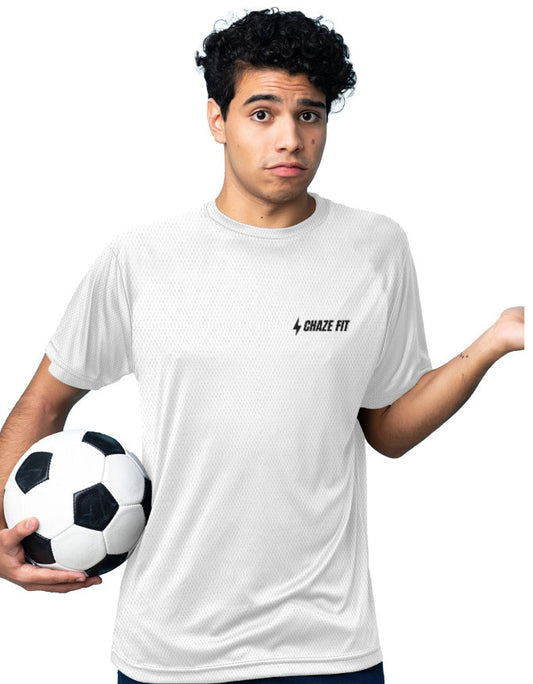
What Is Poly Mesh Fabric? (And Why It Beats Regular Polyester For Sweat)

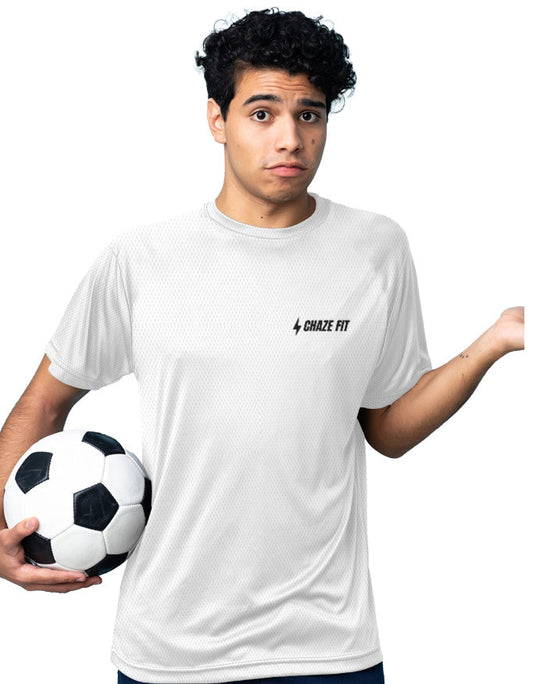
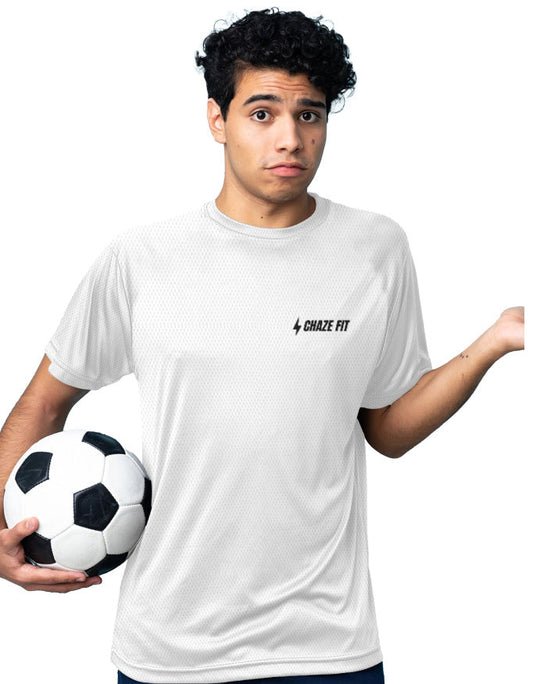
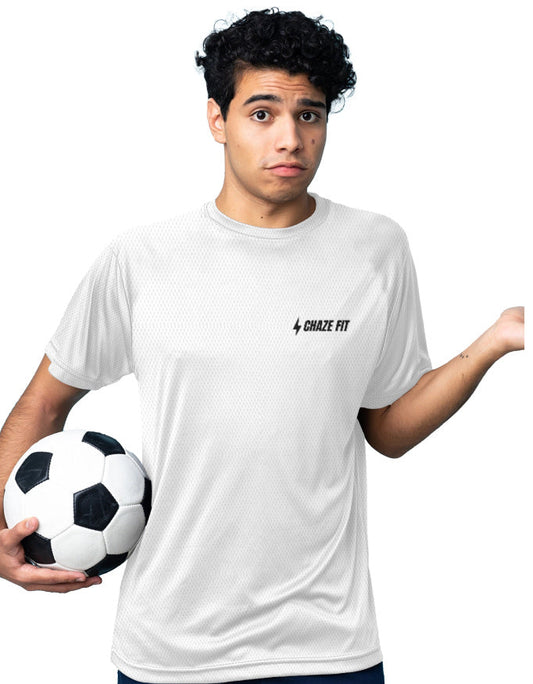
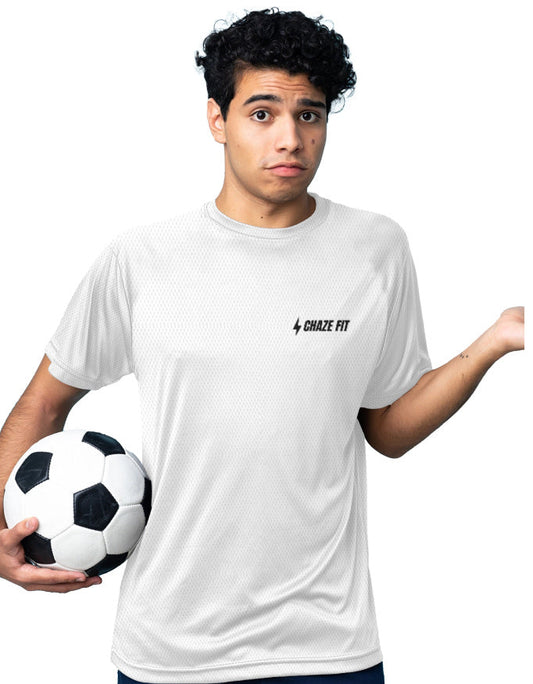
Direct answer: Poly mesh is a knit fabric construction built with deliberate small gaps between fibres, creating open air channels through the material - unlike standard polyester, which is usually a flat, tightly woven fabric with no built-in ventilation. Both are technically "polyester" as a fibre type, but the knit structure of mesh is what actually moves heat and moisture away from skin. This is why the ChazeFit Dri-Fit Sports T-Shirt uses an open poly mesh knit at 170 GSM rather than a flat polyester weave. This 160-180 GSM range for training tees is documented across activewear generally in our GSM Reference Chart.
Polyester Is A Fibre. Mesh Is A Construction. They're Not The Same Thing.
This is the single most common point of confusion in gymwear shopping. "Polyester" describes the raw fibre - a synthetic material spun from petroleum-based polymers. "Mesh" describes how that fibre is knitted or woven into fabric. You can make a flat, dense, poorly-ventilated fabric out of polyester fibre, and you can make an open, breathable mesh out of the exact same fibre. The performance difference between two "polyester" gym tees almost always comes down to this construction choice, not the fibre itself.
Most budget "dri-fit" tees use a flat weave because it's cheaper and faster to produce at scale. Mesh knitting requires more precise machinery to create consistent, deliberate gaps in the structure - which is part of why genuine mesh fabric costs more than flat-weave polyester of the same fibre type.
How The Open Structure Actually Works
Mesh fabric is knitted with small, evenly spaced gaps built into the structure - visible if you hold it up to light. Those gaps do two things simultaneously: they let air pass directly through the fabric (convective cooling), and they increase the surface area exposed to air, which speeds up evaporation of any moisture sitting on the fabric's outer face.
A flat weave has neither advantage. Air has to move around the fabric rather than through it, and the tightly packed fibres give sweat less exposed surface area to evaporate from - which is why flat-weave polyester tees, despite being technically "moisture-resistant" as a fibre, still feel hot and clammy during high-intensity training.
"When people say a fabric feels 'plasticky' and hot, it's almost always a flat weave, not a mesh knit. The fibre gets blamed for what's really a construction choice - we picked mesh for this tee specifically because that's the variable that actually matters for heat." - Ankit Mange, Founder, ChazeFit
The Role Of The Wicking Finish
Mesh construction handles airflow; a separate wicking finish handles moisture transport along the fibre itself. Polyester fibre is naturally hydrophobic, meaning it doesn't absorb water into the fibre the way cotton does. A wicking finish works with this property, pulling moisture along the fibre's surface and spreading it across a wider area of fabric - which the mesh's open structure then evaporates faster than a flat weave could. The two technologies work together: mesh construction plus a wicking finish outperforms either one alone.
GSM And Mesh: Why 170 Is The Working Range For A Training Tee
GSM (grams per square metre) measures fabric density regardless of whether it's mesh or flat weave. A mesh fabric that's too light (under 150 GSM) has gaps so large and fibres so sparse that it loses structural integrity and can look see-through even when dry. A mesh fabric that's too heavy (200 GSM+) starts to lose the open-channel advantage because the gaps become proportionally smaller relative to fibre density. 160-180 GSM is the range where an open mesh knit stays structurally sound, prints cleanly, and still ventilates effectively - which is why the ChazeFit Dri-Fit Sports T-Shirt sits at 170 GSM specifically. We break down what this means for see-through risk in our see-through and clinging guide.
Mesh vs Cotton: A Different Comparison Entirely
It's worth separating this from the mesh-vs-cotton question, which is a fibre-type comparison (synthetic vs natural, hydrophobic vs hydrophilic) rather than a construction comparison. Our poly mesh vs cotton guide covers that comparison in full - this article is specifically about mesh construction versus flat-weave construction within synthetic fabric.
How To Spot Genuine Mesh Before Buying
"Dri-fit" as a label tells you nothing about construction. To identify genuine mesh before buying (especially online, where you can't feel the fabric): look for product descriptions that explicitly mention \"mesh,\" \"open knit,\" or \"ventilated construction\" rather than just \"moisture-wicking\" or \"quick-dry,\" which can describe flat-weave fabric too. Reviews and photos showing the fabric held up to light are a reliable way to confirm an open structure.
Does Mesh Reduce Durability?
A well-constructed mesh knit with a bonded wicking finish holds up comparably to flat-weave polyester in wash testing - the open structure doesn't inherently weaken the fabric if the knit density is correct. The ChazeFit Dri-Fit Sports T-Shirt is tested to 50+ wash cycles at 30°C without loss of shape or print quality, which is the same durability bar applied across ChazeFit's other fabric pieces.
See The Fabric In Action
The ChazeFit Dri-Fit Sports T-Shirt is built on a 170 GSM open poly mesh knit with a genuine moisture-wicking finish - not a flat polyester weave with a marketing label. Priced at ₹799, sizes S-XXL.
Shop the ChazeFit Dri-Fit Sports T-Shirt →
Frequently Asked Questions
1. Is poly mesh the same as polyester?
Polyester is the fibre type; mesh is a knit construction. Poly mesh is polyester fibre knitted into an open, ventilated structure.
2. Why does flat-weave polyester feel hotter than mesh?
Flat weave has no built-in air channels, so heat and moisture stay trapped against skin instead of escaping through the fabric.
3. Does mesh fabric wick moisture on its own?
Mesh construction handles airflow; a separate wicking finish is needed for active moisture transport along the fibre. The two work together.
4. What GSM should a mesh training tee be?
160-180 GSM balances structural integrity, print quality, and breathability for a mesh training tee.
5. Can I tell mesh from flat-weave polyester just by the "dri-fit" label?
No - "dri-fit" is a marketing term used for both. Look for explicit mentions of "mesh" or "open knit" construction instead.
6. Is mesh less durable than flat-weave fabric?
Not inherently - a properly knitted mesh with a bonded finish performs comparably in wash testing when the knit density is correct.
7. Does mesh fabric let too much light through, showing skin?
At the right GSM (160-180), no - the gaps are small enough to stay opaque while still ventilating. Too-light mesh (under 150 GSM) can have this issue.
8. Why is genuine mesh sometimes more expensive than flat-weave polyester?
Mesh knitting requires more precise machinery to produce consistent open structures, which typically costs more than flat weaving.
9. Is the ChazeFit tee mesh or flat-weave?
Open poly mesh knit at 170 GSM, not a flat weave.
10. Does the print work the same way on mesh as on flat-weave fabric?
Yes, provided it's dye-sublimated - the dye bonds into the fibre itself regardless of the knit structure, which is how the ChazeFit print is applied.
11. Is mesh only useful for hot climates?
It's most valuable in hot, humid conditions like most of India, though the breathability benefit applies to any high-sweat activity regardless of ambient temperature.
12. Does mesh construction affect how the fabric feels against skin?
Yes - it typically feels lighter and slightly more textured than a flat weave, which some wearers notice as a more "technical" feel.
Related Articles
- The Complete Guide To Dri-Fit Sports T-Shirts In India
- Why Does Your Gym T-Shirt Turn See-Through And Cling When You Sweat?
- Poly Mesh vs Cotton Sports T-Shirt: Which Is Better For Indian Gyms?
- Best Dri-Fit Sports T-Shirt In India (2026) - Tested & Reviewed
- GSM Reference Chart Across Activewear Categories
Tags:
Previous
Best Dri-Fit Sports T-Shirt In India (2026) - Tested & Reviewed
Next
How To Wash A Dri-Fit T-Shirt Without Losing Moisture-Wicking
Related articles
-
Aug 10 2026