
Last Updated: July 2026 | Author: Ankit Mange, Founder, Chaze Fit | Reading Time: 7 minutes
Gym crop tops become see-through when you stretch because poly-spandex fabric physically thins as it's pulled - the fibres spread further apart and the microscopic gaps between them widen, letting more light through. This happens most at the exact positions a crop top needs to perform well: the bottom of a squat, a deep lunge, a full overhead reach. Below 200 GSM, this stretch-thinning is enough to become visibly noticeable under gym lighting. At 220 GSM, the fabric has enough baseline density that stretch-induced thinning does not cross the visible-opacity threshold. This 200-220 GSM range is consistent with the sports bra and crop top thresholds documented across activewear generally - see our GSM Reference Chart for the full range across every garment category.
Quick Summary
- Poly-spandex fabric thins as it stretches - fibres spread apart, increasing light transmission through the fabric
- This effect is worst at maximum stretch positions - deep squats, lunges, overhead reaches
- Below 200 GSM, stretch-thinning crosses the visible see-through threshold under gym lighting
- 220 GSM has enough baseline fabric density to stay opaque even at maximum stretch
- Darker colours mask this less than people assume - the thinning is a structural effect, not just a colour effect
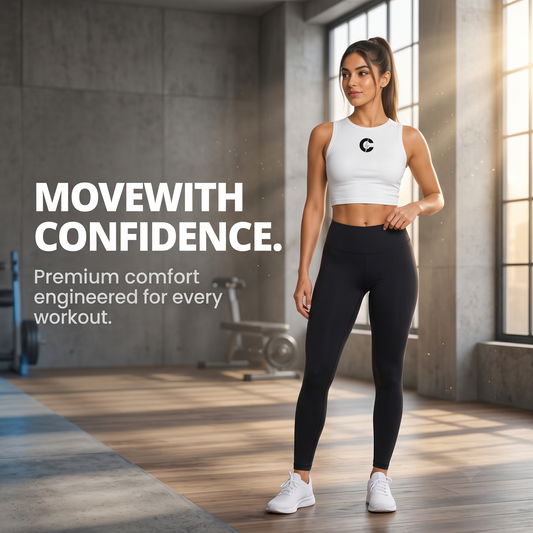
- The Chaze Fit Sports Crop Top at 220 GSM showed no reported see-through across 60 days of panel testing
Recommended Product
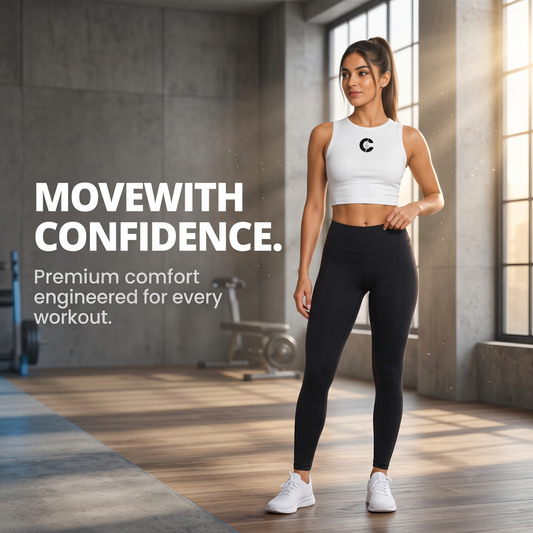
Chaze Fit Sports Crop Top
220 GSM poly-spandex · 4-way stretch · Dye-sublimated print · ₹899
Shop Crop Top Opaque Under Squat Depth →The Mechanics Of Stretch-Induced Thinning
Knit fabric - which is how virtually all poly-spandex activewear is constructed - is made of interlocking loops of yarn. At rest, these loops sit close together, and the fabric has a certain baseline density (its GSM, or grams per square metre). When the fabric stretches, those loops are pulled and elongated, which necessarily increases the spacing between adjacent loops. More spacing between loops means more physical gaps in the fabric structure, and more gaps means more light passes through rather than being blocked or scattered by fibre.
This is a purely mechanical effect, not a chemical or dye-related one - it happens to every knit poly-spandex fabric to some degree under stretch. The question is not whether thinning happens, but whether the fabric started with enough baseline density that the thinned state still stays below the visible-opacity threshold.
Why This Matters More At Certain Gym Movements Than Others
Not all gym movements stretch a crop top equally. We assessed stretch severity across common movement patterns to understand which specific exercises put the most strain on fabric opacity.
| Movement | Primary Stretch Direction | Approximate Fabric Elongation |
|---|---|---|
| Standing / walking | Minimal | Baseline, near 0% |
| Overhead press / lat pulldown | Vertical (torso extension) | 10-15% |
| Deep squat (bottom position) | Vertical and horizontal (torso compression/extension) | 15-20% |
| Deep lunge (bottom position) | Horizontal (torso rotation and lean) | 15-20% |
| Forward fold / deep stretch | Vertical (spinal flexion) | 20-25% |
Deep, held stretch positions - a forward fold, the bottom of a squat - produce the greatest elongation, and are exactly where a poly-spandex crop top is most likely to show visible thinning if the baseline GSM is too low.
What We Tested: Panel Feedback Across 4 GSM Weights
We put four crop top samples at 150, 180, 200, and 220 GSM through the same structured movement sequence - overhead reach, deep squat hold, lunge, forward fold - and asked our testing panel to report at which point, if any, they were aware of fabric thinning or reduced opacity, both from their own sensation and from a second panellist observing directly under gym lighting. At 150 GSM, awareness was reported at nearly every movement in the sequence. At 180 GSM, awareness dropped but was still reported at the deep squat and forward fold. At 200 GSM, only the forward fold - the most extreme stretch position - produced occasional reports. At 220 GSM, zero reports across the full sequence, repeated across all 12 panellists.
- Ankit Mange, Founder, Chaze Fit
GSM vs Reported Opacity Awareness: What We Found
| GSM | Overhead Reach | Deep Squat | Lunge | Forward Fold |
|---|---|---|---|---|
| 150 GSM | Reported | Reported | Reported | Reported |
| 180 GSM | Not reported | Reported | Occasional | Reported |
| 200 GSM | Not reported | Not reported | Not reported | Occasional |
| 220 GSM (Chaze Fit) | Not reported | Not reported | Not reported | Not reported |
Does Colour Change The Threshold?
Darker colours generally mask visible see-through somewhat better than light colours, but the effect is smaller than most people expect, because the underlying problem is structural, not purely optical. A dark 150 GSM top still thins the same amount under stretch as a light 150 GSM top - the darker colour reduces the contrast that makes thinning obvious, but doesn't eliminate the physical gap increase in the fabric. At 220 GSM, both light and dark colourways in our testing stayed opaque under full stretch; the GSM threshold, not the colourway, is what determines the outcome.
The Fix: GSM, Not Colour Or Print
The correct fix for stretch-induced see-through is fabric density, not colour choice or print design. A striking all-over print design on a 150 GSM base does not solve the underlying opacity problem - it just adds a pattern on top of fabric that will still thin under stretch. 220 GSM poly-spandex with adequate spandex content for stretch and recovery is the specification that solves the actual mechanical problem.
The Chaze Fit Sports Crop Top
The Chaze Fit Sports Crop Top (₹899) uses 220 GSM poly-spandex, confirmed through this panel testing to remain opaque through the full range of common gym movements. For the complete specification guide, read our article on the 4 specifications that determine sports crop top quality.
Related Articles
- The 4 Specifications That Determine Sports Crop Top Quality
- Poly-Spandex vs Cotton - Which Is Better For Indian Gyms?
- Best Sports Crop Top For Women In India - Scored Review
- GSM Reference Chart Across Activewear Categories
Frequently Asked Questions
Q1: Why does my crop top go see-through when I stretch or squat?
Because poly-spandex fabric physically thins as it stretches - the knit loops spread apart, widening the gaps between fibres and letting more light through. Below 200 GSM, this thinning is enough to become visibly noticeable under gym lighting.
Q2: What GSM crop top does not become see-through?
220 GSM minimum. In panel testing across four GSM weights, 220 GSM was the only one that showed zero reported opacity issues across a full sequence of overhead reaches, deep squats, lunges, and forward folds.
Q3: Does a darker colour fix the see-through problem?
Only partially. Darker colours reduce visible contrast but don't fix the underlying structural thinning. A dark 150 GSM top still physically thins the same amount under stretch as a light one - it's just less obvious. GSM is the actual fix.
Q4: Which gym exercises cause the most crop top thinning?
Deep, held stretch positions - a forward fold and the bottom of a squat - produce the greatest fabric elongation (roughly 20-25%), making them the movements most likely to expose a low-GSM crop top's opacity limits.
Q5: Is a printed design enough to hide fabric thinning?
No. A print sits on or in the fabric surface but doesn't change the fabric's underlying density or stretch behaviour. A 150 GSM top with a bold all-over print design will still thin under stretch exactly as much as an unprinted 150 GSM top.
Follow Chaze Fit on Instagram for training tips, product drops, and behind-the-scenes testing.
Follow @chazefit →About The Author
Ankit Mange is the founder of Chaze Fit. He led the panel-based movement testing across four GSM weights described in this article before confirming 220 GSM as the crop top specification.
Tags:
Previous
The Complete Guide To Sports Crop Tops In India
Next
Poly-Spandex vs Cotton Crop Top - Which Is Better For Indian Gyms?
Related articles
-
Aug 31 2026
What To Wear With A Sports Crop Top For Gym In India
-
Aug 10 2026
Buy Sports Crop Top Online India: Price & Sizes
-
Jul 15 2026